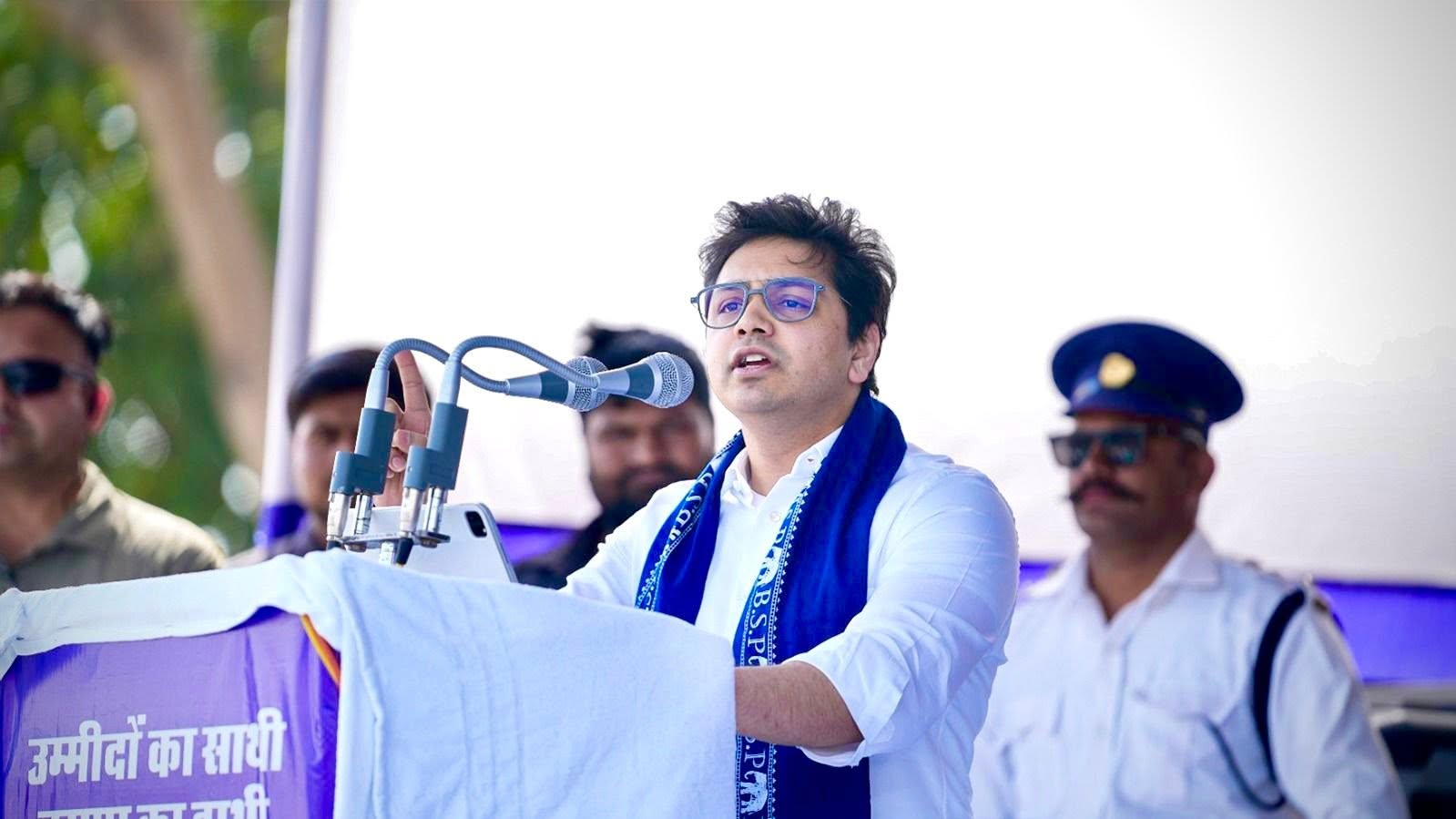
Lucknow: BSP supremo Mayawati has once again placed her bet on her most trusted young face—Akash Anand. The way Akash made his comeback at a party worker conference held in Sadabad, a seat in Hathras district of western Uttar Pradesh, as part of the buildup to the 2027 UP Assembly elections, has ignited a new debate in state politics. After a period of political exile and being sidelined by Mayawati, Akash has returned in his new role as National Coordinator looking more mature, composed, and strategically sharper than before. He leveled attacks against the BJP, SP, and Congress alike, presenting all three as forces opposed to the interests of the common masses. But the biggest buzz from this rally didn’t come from any policy announcement—it came from a single word he used for Rahul Gandhi and Akhilesh Yadav: “Uncle.”
Akash Anand refused to address Congress leader Rahul Gandhi and Samajwadi Party chief Akhilesh Yadav as “brother” (bhaiya), saying that for the younger generation, they were “uncles” (ankul). Akhilesh Yadav has long addressed Mayawati as “Aunt” (bua ji) in Uttar Pradesh politics. By flipping this language of kinship, Akash positioned himself as the next generation of youth and cast Akhilesh and Rahul as old-guard leaders. The attack was less about age and more about political rebranding.

New Politics, New Language
This is where Akash Anand’s new political strategy becomes visible. At nearly thirty years old, he wants to establish himself as a leader who can speak to youth in their language. Issues like paper leaks, unemployment, the crisis in competitive exams, expensive education, and insecurity about the future have become crucial parts of young voters’ political concerns in Uttar Pradesh. The “uncle” jibe is the promotion-worthy component of this strategy.
The BSP’s biggest challenge is not just the BJP or the Samajwadi Party, but its own shrinking social base. In 2007, Mayawati made history in UP politics by securing an absolute majority through social engineering. The strategy of combining the Dalit base with Brahmins and other social groups became the BSP’s greatest electoral success. But after 2012, the party’s graph has been consistently declining. In the 2017 Assembly elections, the BSP was reduced to just 19 seats, even though its vote share remained around 22 percent. The situation worsened in 2022 when the party won only one seat and its vote share dropped to approximately 12.8 percent. In the 2024 Lok Sabha elections, the BSP didn’t even open its account. These results signaled an organizational and social coalition crisis.
The Dalit Vote Slipping Away
The biggest political fallout from this crisis has been visible within Dalit votes. Particularly in western Uttar Pradesh, Chandrashekhar Azad of the Akhil Samaj Party has built an image of aggressive, resistance-based politics among Dalit youth. His success in the Lok Sabha elections indicated that the BSP’s traditional voter base would no longer automatically stay with its old leadership. Holding the first major rally in regions like Hathras signals that the BSP wants to fight directly for its ground among Dalit youth.
During the 2024 Lok Sabha campaign, Mayawati had sidelined Akash following some of his aggressive statements and removed him from his role as National Coordinator and heir apparent. After the election results, the party faced the question: how would it reach the new generation without a young face? This pressure created the conditions for Akash’s comeback. This time, he must balance aggression with discipline. Mayawati has entrusted him with fieldwork responsibility.
BSP’s 2027 Strategy
The BSP’s strategy for 2027 has a first objective: reactivating its cadre. The party knows that elections cannot be won through social media or big rallies alone. Ground-level workers, sector committees, and voter contact are its real foundation. So efforts are underway to energize the organization by giving youth greater responsibility. Through social media, digital campaigns, and new political language, Akash could attempt to transform the BSP’s traditional image. If successful, the party’s message will go beyond its old cadre.

The second major challenge is the Samajwadi Party’s PIDA equation. In the Lok Sabha elections, the SP made backward classes, Dalits, and minorities the central basis of its politics. This is a direct challenge for the BSP, since Dalit votes have been its most important political foundation. Akash Anand’s attacks on the SP are not merely personal commentary on Akhilesh Yadav. Behind it is the message that the real authority over Dalit representation belongs to the BSP.
Congress is also an important rival in the BSP’s strategy. Rahul Gandhi’s campaigns on the Constitution, social justice, and reservation have carved out new space in opposition politics. Calling him “uncle” is an attempt to challenge his political appeal. The message is clear: representation of the new generation will be determined by ground-level organization and standing firm on issues affecting the common masses.
The Real Test Begins After the Speech
But the real test begins after the speech ends. The BSP faces three battlefronts simultaneously: regaining voter confidence, strengthening the organization down to the booth level, and changing the perception that the party has become electorally weak. Akash Anand’s popularity will only become political capital when it manifests through regular public engagement, attention to local issues, and strong candidates.
The Muslim-Dalit equation is also an important part of the BSP’s potential strategy. Efforts to reduce political distance between these two communities in western Uttar Pradesh could create new opportunities for the party. The BSP must prove that it is not merely a third option but can be the real force for change in government. For this, it must work on organization, candidate selection, and local social equations.
Therefore, dismissing the “uncle” message emanating from Hathras as merely a viral statement would be a political mistake. This is the BSP’s attempt to change generational politics. Mayawati wants to remain the backbone of the party with her experience and control, while Akash Anand is being positioned as the face of the new generation. Between the BJP’s strong organization, the SP’s PIDA alliance, and Congress’s constitutional discourse, the BSP must carve out its own distinct space. In 2027, the biggest question before it will not be the number of seats but whether it can restore a political identity to its scattered social base. This will be the real test of the BSP’s comeback in 2027. If Akash Anand succeeds in building trust among youth, Dalits, and the common masses, “uncle politics” could transform from a catchphrase into a weapon in the BSP’s electoral strategy.




 ---------------------------------------------------------------------------------------------------